Building Lifelong Readers: How Liberty County Schools Use Junior Great Books to Inspire Young Learners

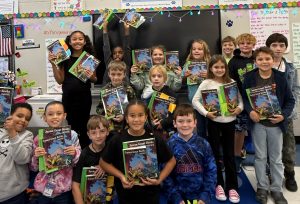
In Liberty County, Georgia, approximately 500 students in grades K–5 are discovering the transformative power of literature through a program that has become central to their gifted education: Junior Great Books® (JGB). Through JGB programs, students read and explore carefully curated collections of stories and poems using the Shared Inquiry™ method, a discussion-based approach that’s reshaping how gifted students think, read, and engage with complex ideas.
Becky Busby, the K–12 Gifted Facilitator for Liberty County Schools, has been instrumental in this success. Busby has 20 years of her own experience with Junior Great Books to draw upon and has brought JGB to the district’s seven elementary schools over the past two years. She has witnessed firsthand how the program transforms reluctant readers into passionate learners and develops critical thinking skills that extend far beyond the classroom.
Why Junior Great Books?
Liberty County’s gifted program operates differently from traditional classroom instruction. Students spend four days a week in their regular classrooms and one day a week in a gifted resource class where they work with specialized teachers. This pullout model allows the district to offer a curriculum distinct from what students experience in their regular classes—a deliberate choice that avoids duplication and keeps students engaged.
“We didn’t want to overlap with what they were already doing in their classroom,” explains Busby. “The program started using Junior Great Books to really push the students and give them those opportunities to dig deeper into stories and to have those deep conversations about the story.”
Teachers needed materials that would challenge gifted learners while avoiding curriculum already in use. Junior Great Books proved to be the perfect fit—offering high-quality, thought-provoking selections that spark the kind of meaningful discussion Busby calls essential to developing confident, curious students.
“Our students love them,” Busby notes. “Our teachers love them, too.”
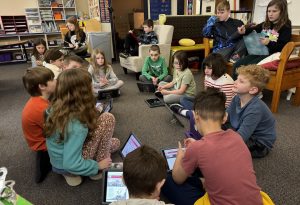
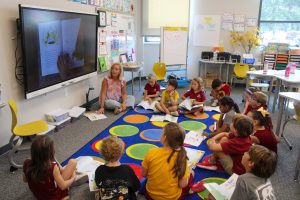
One key reason for this widespread enthusiasm is the program’s structure around Shared Inquiry, which transforms passive readers into active thinkers. Through guided questioning and facilitated discussion, students learn to develop their own interpretations, challenge assumptions, and construct meaning from text.
The Power of Passionate Engagement
What stands out most in Busby’s experience is how the program engages even the most reluctant readers. “Non-readers, students that don’t like to read, they get so engrossed in these stories, and they get so attached to these characters,” she explains. “It just makes you have really deep conversations that you don’t get when you’re in front of an iPad on an app or anything like that.”
The cliffhangers in many Junior Great Books selections create a particularly powerful effect. Rather than frustrating young readers, these open endings spark curiosity and debate. “The great thing about those cliffhangers is it gets them to think deeper and it gets them to use their imagination,” Busby says. “Teachers get to ask them: How would you end the story? What would you do if you could introduce a new character?”
This approach has proven so effective that Busby and her teachers repeatedly witness students making new discoveries in stories they’ve explored with students in the past. “Every year, we have students in class that think of a different point of view, or they think of different questions to ask,” she recalls. “It never fails.”
Extending Learning Through Creativity
One of the hallmarks of Liberty County’s approach to Junior Great Books is the integration of extended learning activities—art, drama, writing, and STEM projects that build on students’ engagement with the texts.
A particularly compelling example demonstrates this integration. During a lesson when Busby was still in the classroom, her first and second graders were preparing to read “City Mouse and Country Mouse” from Junior Great Books Series 1. She had recently purchased STEM kits featuring coding mice—toys that students could program to navigate through different spaces to reach cheese. The kits remained unopened.
As the class anticipated discussing the story with genuine enthusiasm, a new student raised his hand. “Ms. Busby,” he asked quietly, “do you think that next week, when we read the story, we could use those?” He pointed to the mouse kits.
Rather than wait, Busby made an immediate decision. She opened the packages on the spot and had students code the mice to find the cheese. What could have remained separate learning experiences—a Junior Great Books story and a STEM activity—became a unified, rich exploration that deepened student engagement with both.
“That was inspired by the student! It carried over that passion and that excitement that, again, you wouldn’t necessarily get if you just read a passage about mice,” Busby reflects.
Building Beyond the Classroom
Perhaps most importantly, Liberty County’s use of Junior Great Books extends beyond immediate academic gains. Teachers across the district have observed that the questioning strategies and discussion practices students learn through Shared Inquiry transfer to other subject areas—particularly STEM, where open-ended problem-solving mirrors the open-ended inquiry at the heart of Junior Great Books discussions.
“Especially when you talk about STEM and getting students to participate in the engineering design process, you are asking questions and trying to answer them to find solutions. In Junior Great Books, it’s hard in Shared Inquiry not to interject your thoughts. You have to only ask questions. You have to really lean into just asking questions.
“When you are trying to be a good STEM teacher you have to do the same thing to get students to think outside the box and solve problems on their own. You have to let them self-discover that journey.”
A Legacy of Lifelong Reading
For Busby, the ultimate measure of success isn’t standardized test scores or academic benchmarks, though those matter too. It’s the lasting impact on students’ relationship with reading itself.
“Junior Great Books teaches kids to love reading,” Busby observes. “If I want to have a legacy, it would be to make kids lifelong readers and make them love to read a book—to open a book about anything.”
This vision—creating lifelong readers who love literature—is exactly what Junior Great Books is designed to do. By combining carefully selected, challenging texts with a discussion method that honors student voice and curiosity, the program has become integral to how Liberty County Schools develop not just better readers, but more thoughtful, engaged learners.
Learn More
Would you like to create passionate readers in your classrooms? We can help you choose the right Junior Great Books programs for students of all abilities and set up Shared Inquiry professional learning for your teachers. Bring enthusiasm and engagement to your school or district! Get in touch today.

Director of Marketing and Development
Dan Lindstrom is the director of marketing and development for the Great Books Foundation. He promotes the important work that the Foundation does for lifelong learners, helping all who are interested to take part in civil discussions about outstanding literature and other objects of inquiry. During his 30 years with the Foundation, he has spoken with dozens of educators who love how Junior Great Books encourages children to express their own opinions about what they have read.