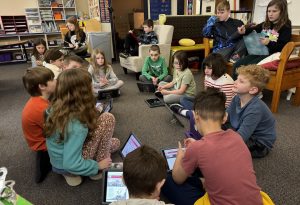
Productive Student Discussion Builds Better Readers

The Science of Reading and Oral Language Development
How do we ensure that all students not only learn to read initially, but continue to develop as readers? Now that knowledge of the principles of the science of reading is spreading among educators and the public, attention increasingly turns to practical matters of implementation and variances by grade level or student characteristics. Are there best practices that enable all readers to thrive and grow?
Oral language development is one essential component of effective literacy instruction for all students that draws on a deep research base and helps bridge the gap between theory and practice. Research consistently shows that reading comprehension improves when learners are engaged in purposeful, effective speaking, listening, and collaboration.1
The Science of Reading and Language Comprehension
Looking at the basics of the science of reading helps us understand why the “language arts” of reading, speaking, listening, and writing are so closely intertwined. The Simple View of Reading starts with two key components: word recognition (WR in the diagram below) and language comprehension (LC).
Being able to sound out letters into words only leads to reading comprehension when multiplied by one’s comprehension of those words as spoken language. If we don’t know a word, the sounds alone aren’t enough; we need to already know (or find out) what word those sounds signify. When readers are surrounded by rich oral expression, they are better able to understand a larger number of written words, expressions, and other aspects of language use.

Scarborough’s Reading Rope helps us further understand the multiple dimensions and importance of oral language comprehension. Here, the two major strands (WR on bottom and LC on top) are shown being woven together over time, so that word recognition becomes “increasingly automatic,” and language comprehension becomes “increasingly strategic.”
Instruction and experience with phonics, phonemic awareness, and word recognition (the lower strand) are necessary but not sufficient.2 Purposeful, sustained practice in combining and developing the two strands is enhanced at every age by also paying attention to language development, and especially by having readers respond to and discuss what they read.
When students engage in collaborative discussion about the meaning of what they are reading — rather than just answering teacher questions about the sounds or the facts in a text — comprehension improves and students grow as readers. Productive student discourse not only exposes students to more uses of language, but situates that learning in contexts where the language use is strategic and purposeful.

Receptive and Expressive Language
Both receptive and expressive language are vital for students’ learning and literacy development. Receptive language (listening) is the input—what we hear when we are processing sounds as meaningful. Listening to texts read aloud and hearing others speak about what they read builds receptive language skills. Expressive language is the output—what students are saying, whether that’s a one word response to the teacher or focused, sustained conversation with peers.
Obviously, to become more skilled communicators, students need to practice! Purposeful communication contributes to both receptive and expressive language development, especially during discussion-based activities, as students hear and respond to questions and to one another, as they construct deeper understanding of complex texts.
Despite differences in their needs and approaches to support them, a report from the National Committee for Effective Literacy emphasizes that both monolingual and multilingual learners benefit from this emphasis on supporting language development:
“Building oral language is both an EL/ELD second language issue, and a matter of building opportunities and structures for student talk / discourse into all curriculum for all students. It is how ELLs internalize the sounds, structures and vocabulary in English.”3
Characteristics of High-Quality Student Discussion
Many studies across grade levels have investigated patterns of teacher questioning, student responses, and their impact on learning.4 A key shared conclusion is that the quality of student talk matters. For reading comprehension in particular, just increasing quantity of student talk does not necessarily increase comprehension.5
As Joan Sedita explains in her series of posts focused especially on discussion for students in grades 6-12:
Talk that is structured and focused, yet not dominated by the teacher, is necessary to support comprehension. This includes students discussing texts using open-ended questions for extended periods of time, prompted by the teacher or other students. It also includes the teacher or students incorporating the ideas of others into their questions and building on each other’s ideas.6
Complex texts that raise essential questions provide an excellent foundation for both direct and indirect language development and thus reading comprehension, as well as for vocabulary and knowledge building, fluency practice, and more. Exploring rich texts via a collaborative, inquiry-based approach provides even more benefits by incorporating other elements that the science of learning has shown to increase student engagement, executive functioning, and help foster vibrant learning communities.
Shared Inquiry and Junior Great Books
The Shared Inquiry method and the award-winning texts used in Junior Great Books help teachers and students learn to participate in increasingly strategic, increasingly automatic civil discourse and collaboration across the curriculum. Read-alouds and audio versions support all students during sustained interaction over multiple readings. Fluency practice, dramatizations, and other scaffolding and differentiation help support all students in making and expressing meaning.
The teacher’s role in all Shared Inquiry activities includes modeling and coaching reading and critical thinking skills, all while using and encouraging academic language. This is especially true during the core Shared Inquiry discussions, where the teacher only asks questions, both open-ended ones about the text and follow-up questions based on student responses. Students gradually take more responsibility for speaking directly to one another and driving the inquiry, again with differentiated support from the teacher. Language development and deep reading comprehension (and subject matter knowledge) are mutually reinforced throughout.
Decades of research and many multi-year implementations in a wide variety of classrooms across the world have demonstrated the power of this productive student discussion model to help build better readers, thinkers, and communicators.7 Learn more about Great Books professional development in the collaborative, Shared Inquiry approach for all ages and see the outstanding texts in Junior Great Books programs for grades K-8. Schedule a meeting with your Great Books K–12 partnership manager to discuss classroom materials and the perfect mix of professional learning for your setting!
- Burns, M., Griffin, P., Snow, C. Starting Out Right: A Guide to Promoting Children’s Reading Success. National Academy Press, 1999. http://www.nap.edu/download/6014; Mehta, P.D., Foorman, B.R., Martin, L., & Taylor, W.P. “Literacy as a unidimensional multilevel construct: Validation sources of influence and implications in a longitudinal study in grades 1 to 4.” Scientific Studies of Reading, 2005 (2), 85-116; Pennington, Bruce, F., McGrath, Lauren M. and Peterson, Robin L. Diagnosing Learning Disorders: From Science to Practice 3rd Edition. New York: The Guilford Press, 2019.
- Huebeck, Elizabeth. “Teachers Are Still Teaching Older Students Basic Reading Skills, Survey Finds.” Education Week, 1 May 2024.
- Laurie Olsen, PhD. “Comprehensive Literacy Instruction for English Language Learners.” National Committee for Effective Literacy.
- Mercer, N., and Dawes, L. “The Study of Talk between Teachers and Students, from the 1970s until the 2010s.” Oxford Review of Education, 31 July 2014.
- Wilkerson, I.A.G., and Nelson, K. “Role of Discussion in Reading Comprehension.” International Guide to Student Achievement. New York: Routledge, 2013, pp. 299-302.
- Sedita, Joan. “Discussion to Support Learning, Part 1.” Keys to Literacy, 7 January 2025. https://keystoliteracy.com/blog/discussion-to-support-learning-part-1/
- The Great Books Foundation. Evidence for the Effectiveness of Great Books K-12 Programs and Inquiry-Based Learning. https://drive.google.com/file/d/1-IZ_NsQryafCzR7WGebmfLOpJt4qkJFe/view?usp=drivesdk

Senior Academic Consultant
Denise Ahlquist has enjoyed leading thousands of Shared Inquiry discussions with participants ranging from ages 4 to 99, across the United States and abroad. A veteran educator and “road warrior,” she has introduced thousands of other teachers and learners to the Shared Inquiry method and supported them in a wide variety of K–12 environments.